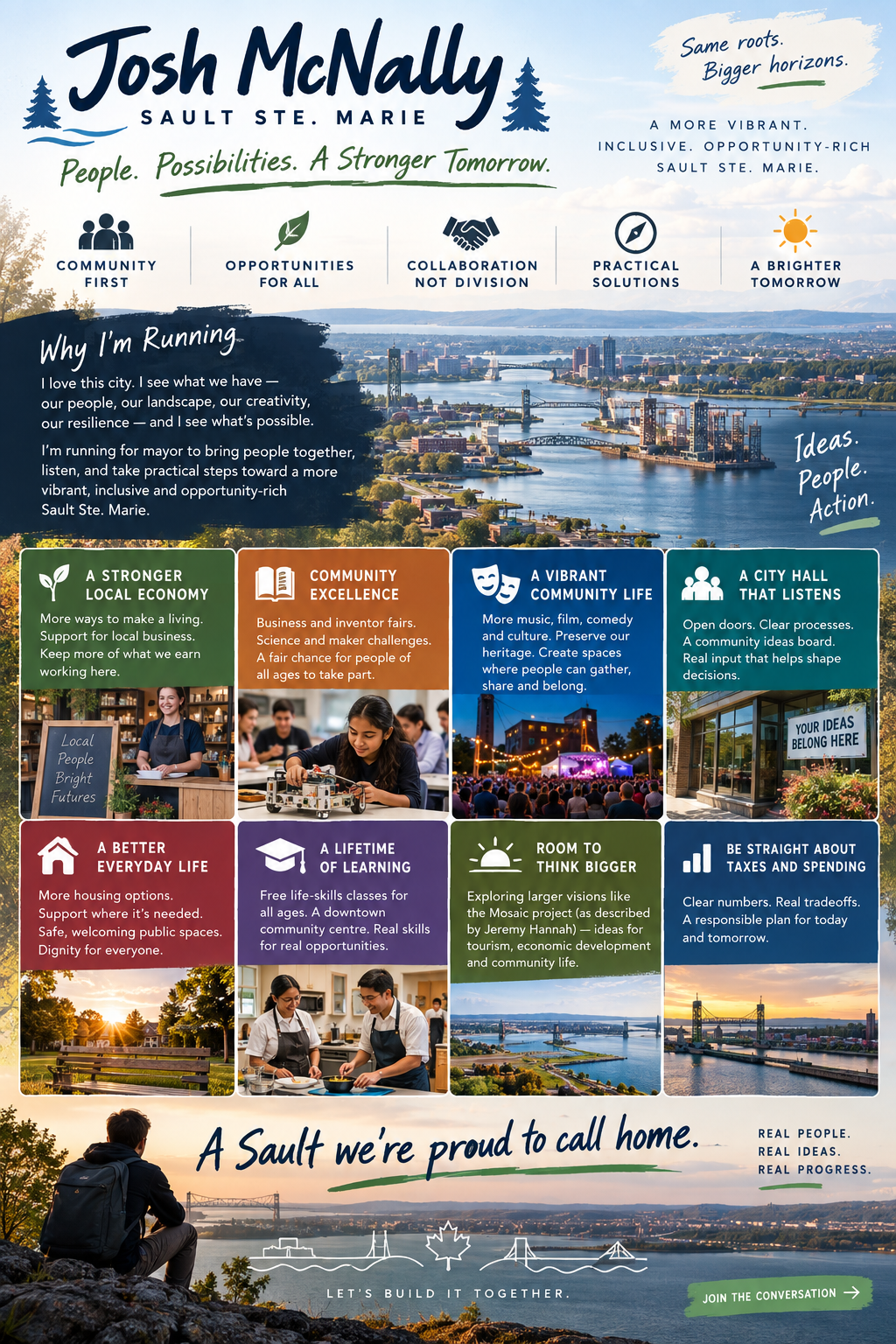
Tourism and creative work for a broader economy. Affordable homes, accessible care, and individualized support for a better everyday life.
↔ Your pace. Swipe, tap an arrow, or choose a chapter.
01 / 10
Local opportunity
Tourism. Creativity. Opportunity.
Make tourism and creative work central to a broader economy, alongside industry, trades, and local business.
↗
Help people start
Connect skills and ideas with support and suitable space, including food-truck parks with utility tie-ins and fair contributions alongside restaurants.
◎
Keep value here
Find purchasing gaps that competitive local suppliers can fill, while helping businesses sell beyond the city.
⌁
Local talent, wider audiences
Explore a destination music festival, fair arts support, busking, and connected food and heritage experiences. Help visitors stay longer and creators earn here.
Make, move and trade. Support a modern public-access port that connects marine, rail, road and industrial land—with transparent, bounded municipal risk.
Create a visible path from learning and practice to useful feedback and a real next step.
1LearnBuild a skill
2PractiseMake it better
3FinishComplete the work
4ShowMeet an audience
5ContinueFind the next step
Open doors, clear rules
Business and inventor fairs, science challenges, performances, and public opportunities should have open entry, published criteria, and fair selection.
Residents should be able to raise an idea, follow it, and understand the answer.
01
Bring it forward
A clear place for a question, proposal, or concern.
02
See what happens
Know who is responsible and what the next step is.
03
Get an answer
Publish the reasoning, trade-offs, decision, and result.
A community ideas board can widen participation—but public input, formal decisions, practical help, and campaign communication must remain clearly separate.
Take social disorder and despair seriously: understand each person's needs, make shared spaces safer, and judge the response by what actually improves.
Voluntary, coordinated care
Timely treatment, primary care, and support shaped around the person. Work with existing organizations to fill gaps; forced treatment is not a general solution to homelessness.
Affordable, accessible homes
Support rental supply and housing partnerships. Pursue a workable vacant-home tax and advocate for provincial income supports that better reflect basic needs.
Safety and dignity together
Address harmful behaviour and unmet needs. Protect shared spaces without treating displacement as a solution.
Follow the evidence
Measure lasting housing, health, stability, and gaps in care. Adapt services and resources when the evidence changes.
Widen practical choices. Remove unnecessary barriers. Keep public opportunities open and understandable.
Connections to a candidate, donor, adviser, business, or official should create no entitlement to public work.
$
Be straight about taxes and spending
Show startup and annual costs, staff time, maintenance, funding sources, and effects on other priorities.
Distinguish confirmed money from hoped-for money—and real efficiency from a cut in service.
Pause large-scale data-centre applications: support a moratorium while water demand, environmental impacts, lasting jobs, and public liabilities are examined with affected First Nations.
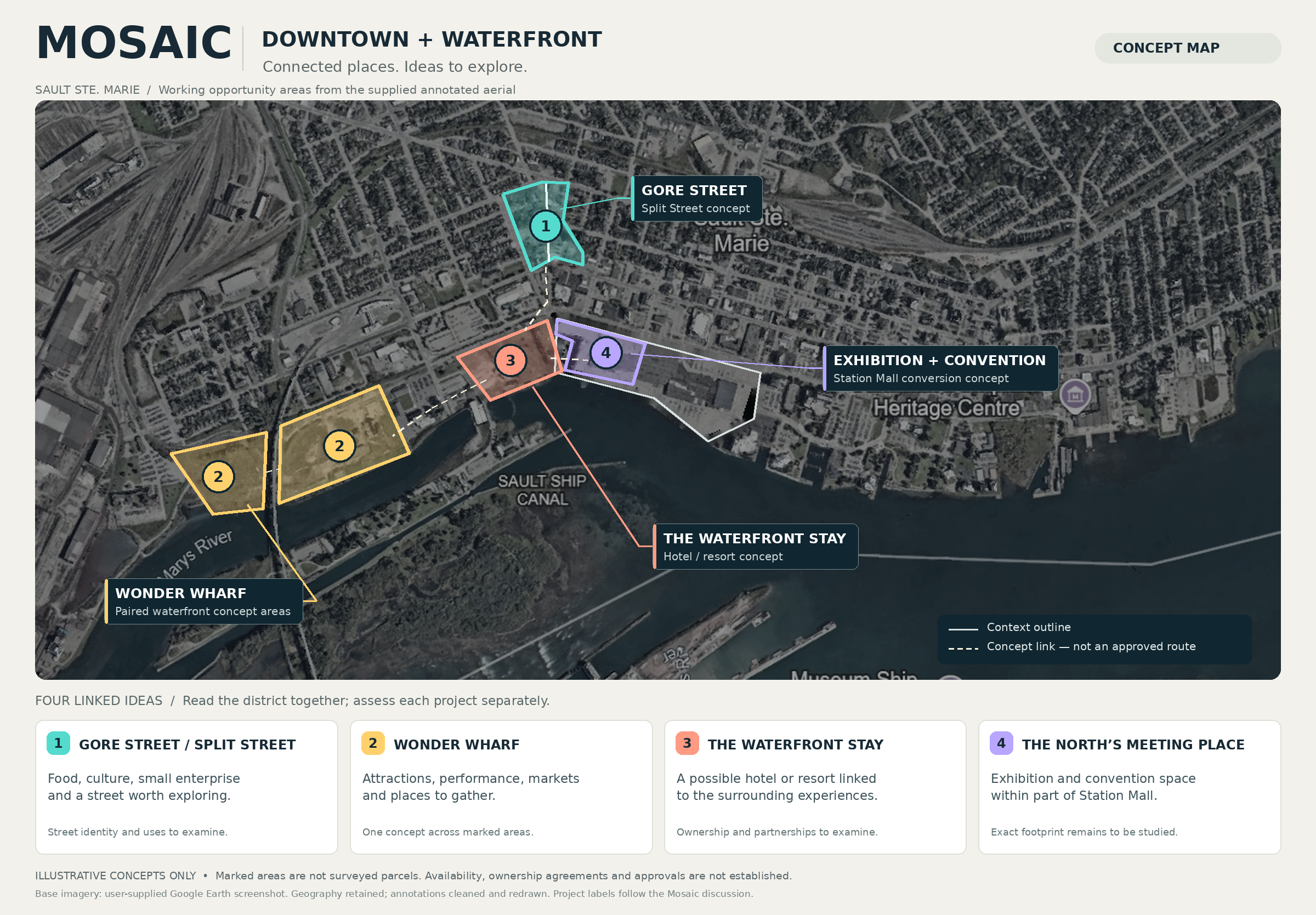
Mosaic asks how downtown, waterfront, buildings, rail, and surrounding landscapes could work together to diversify the economy and give people more reasons to build, visit, and stay.
Explore the possibilities—not promises. Test demand, cost, ownership, partners, approvals, public value, and long-term operation one idea at a time.
View the full-size concept map ↗Illustrative opportunity areas—not surveyed parcels, approved routes, or project commitments.10 / 10
Use the buttons or swipe sideways on a touchscreen. When the reader is focused, ← / → turn pages and Home / End go to the first / last page. On small screens or with enlarged text, scroll the page normally to keep reading.